Finding the right baby diaper manufacturer is arguably the most critical decision you will make for your baby care brand. According to the Grand View Research, The global baby diapers market size was estimated at USD 78.54 billion in 2024 and is projected to reach USD 114.59 billion by 2030, growing at a CAGR of 6.6% from 2025 to 2030. The global baby diaper market is a multi-billion dollar industry, and its entire value is built on a single, fragile foundation: trust. Parents trust that the product you sell is safe, comfortable, effective, and consistent. A reliable manufacturing partner is the cornerstone of that trust.
This comprehensive guide will walk you through every stage of the process. We will explore the technical specifications of a quality diaper, the non-negotiable world of certifications, the strategic choice between OEM and ODM, and the detailed vetting process to find a partner worthy of your brand. Whether you are launching a new private label diaper brand or looking to switch suppliers for an established line, this is your ultimate resource for making an informed, confident decision.
Why Your Choice of Manufacturer Defines Your Brand
Before we dive into the “how,” let’s firmly establish the “why.” Your manufacturer isn’t just a supplier fulfilling an order. They are, in every practical sense, your silent partner. Their production quality, their reliability, and their ethical standards are invisibly stamped onto every product you sell. Their successes are your successes, and more importantly, their failures become your failures.
- Product Consistency: A great partner ensures product consistency, meaning the 100,000th diaper is identical in quality and performance to the first sample you approved. Inconsistency is a brand-killer in the diaper industry, leading directly to negative reviews, broken customer loyalty, and a reputation for being unreliable.
- Safety and Compliance:The materials touching a baby’s delicate skin are non-negotiable. A top-tier manufacturer not only claims to use safe materials but proves it by adhering to strict global standards and holding the certifications to back them up.
- Scale:As your brand grows, you need a partner who can scale with you. A small factory might offer an attractive initial price, but can they handle a 10x increase in order volume without their quality control shattering and their lead times tripling? A reliable manufacturer has the infrastructure and processes in place to grow alongside your success.
- Innovation:Finally, the best manufacturers invest in innovation. They have R&D departments exploring new materials, more absorbent core technologies, and emerging eco-friendly diaper production trends. This partnership gives you access to innovation without you having to fund the entire R&D lab yourself.
Choosing the wrong partner is not a simple mistake. It can lead to catastrophic outcomes: production delays that leave you out of stock, quality control nightmares that result in leaky diapers and angry customers, or even a full-blown product recall that can cause irreparable damage to your brand’s reputation.
The Anatomy of a Quality Diaper
To find a quality baby diaper manufacturer, you must first be able to speak their language. You don’t need to be a chemical engineer, but you do need to understand the core components of a modern diaper. This knowledge is essential for evaluating baby diaper samples and writing your product specifications. A diaper is a complex, multi-layered product, and each layer has a critical job.
Topsheet
The Topsheet is the soft, non-woven fabric layer that rests directly against the baby’s skin. This is the “comfort” layer. It must be hypoallergenic, exceptionally soft to the touch, and made from materials like polypropylene (PP). Its primary function is to quickly wick moisture away from the skin and into the core, keeping the baby feeling dry to help prevent diaper rash.
Acquisition Distribution Layer
Just beneath the topsheet lies the Acquisition Distribution Layer (ADL). You can often see this as a thin, sometimes blue or green, pad. Its job is to rapidly capture liquid and spread it evenly across the absorbent core. This prevents “pooling” in one spot and allows the core to absorb liquid more efficiently.
Absorbent Core
The Absorbent Core is the “engine” of the diaper. This is where the real performance happens. It’s typically a combination of two key materials. The first is Fluff Pulp, which is often sourced from wood. This provides the structure for the core and handles the initial absorption. When vetting a supplier, you should ask if their pulp is Totally Chlorine-Free (TCF) or at least Elemental Chlorine-Free (ECF). The second, and more critical, component is the Super Absorbent Polymer (SAP). These are tiny, dry crystals that can absorb and lock in many times their own weight in liquid, turning it into a gel. The quality, quantity, and placement of the SAP directly determine the diaper’s total absorbency and “dry-feel.”
Backsheet
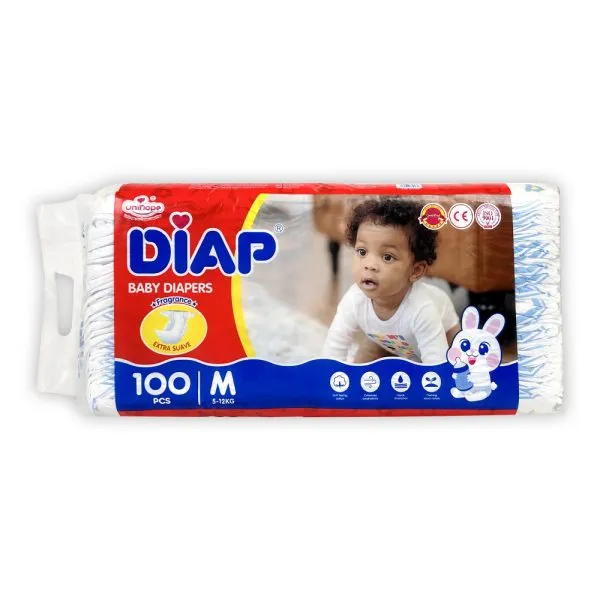
The Backsheet is the waterproof outer layer. In the past, this was a stiff, plastic-like sheet, but modern backsheets are “breathable.” This means they are made of a special film that allows air and water vapor (humidity) to escape, which significantly improves comfort and skin health, but is still completely waterproof to stop liquid leaks. This backsheet is also the layer that is printed with your brand’s designs.
Fastening System
The Fastening System includes the sticky or Velcro-style tabs and the frontal “landing zone” they attach to. A good system is vital for a secure fit and should allow for multiple re-fastenings without losing its grip. Finally, the Elastics in the leg cuffs and waistband are critical for creating a snug, gap-free fit to prevent leaks. These should be strong but soft, and it’s best to ensure they are latex-free to avoid allergic reactions.
Decoding Certifications: Your Non-Negotiable Checklist
Certifications are your first and most important screening tool. They are not optional. They are the independent, third-party proof that a manufacturer adheres to specific quality, safety, and ethical standards. Do not even begin a serious conversation with any diaper supplier who cannot or will not provide the following types of certifications.
Quality & Production Systems
ISO 9001: The global standard for a Quality Management System (QMS). This proves the factory has documented, consistent processes for production, quality control, and continuous improvement.
ISO 13485: The quality management standard for medical devices. Since high-quality diapers are often classified as Class I medical devices, this certification signals an even higher commitment to safety, hygiene, and product traceability.
GMP (Good Manufacturing Practice): Ensures that products are produced and controlled in a clean, hygienic environment, which is critical for a baby product.
Material Safety & Skin-Friendliness
FDA (U.S. Food and Drug Administration): Required if you plan to sell in the United States. This confirms the manufacturer is registered with the FDA and uses materials that are approved for their intended use.
CE Mark: The equivalent for the European Union, indicating the product meets the EU’s high safety, health, and environmental protection requirements.
Ethical & Eco-Friendly Sourcing
FSC (Forest Stewardship Council): This ensures that the wood pulp used in the absorbent core comes from responsibly managed forests, protecting biodiversity and local communities.
Vegan / Cruelty-Free: Guarantees no animal products are used and no animal testing was performed.
Any manufacturer who is proud of their quality will have most of these certificates readily available, often displayed on their website or included in their initial sales packet. If they are hesitant to share them, consider it a major red flag.

OEM vs. ODM: Choosing Your Production Model
Once you start contacting suppliers, you will immediately encounter two acronyms: OEM and ODM. Understanding the difference between them is a critical strategic decision that will define your product, budget, and time-to-market.
1. OEM stands for Original Equipment Manufacturer.
OEM stands for Original Equipment Manufacturer. In this model, you provide the full, detailed product design to the factory. This includes your exact material specifications, diaper dimensions, core composition, design files, and packaging. The factory simply acts as your manufacturing arm, building your product to your exact specs. This path is about full control and creating a truly unique product.
2. ODM stands for Original Design Manufacturer
This is also known as private label. In this model, the baby diaper manufacturer has already done the R&D and has a catalog of pre-designed, pre-tested, and production-ready diaper models. You simply choose a model from their catalog, and they will produce it with your branding and packaging. This baby diaper OEM service is about speed-to-market and lower upfront investment.
| Feature | OEM (Original Equipment Manufacturer) | ODM (Original Design Manufacturer) |
| Design & Concept | Provided entirely by you (the brand). | Provided by the manufacturer; you choose from a catalog. |
| Intellectual Property (IP) | You own the product design and IP. | The manufacturer owns the product design and IP. |
| Upfront Cost | High. Requires significant investment in R&D, design, and new tooling/moulds. | Low. R&D and tooling costs are already absorbed by the manufacturer. |
| Time-to-Market | Long (6-12+ months). Involves extensive development, sampling, and testing. | Fast (1-3 months). The product is already designed and tested. |
| Product Uniqueness | Completely unique. Your product is proprietary and cannot be copied. | Low. Your competitors can use the exact same product from the same factory. |
| Best For | Established brands, well-funded startups, or brands with a unique technical innovation. | New startups, small businesses, or brands testing a new market with minimal risk. |
The Vetting Process: A Step-by-Step Guide
You’ve shortlisted potential manufacturers based on their certifications and their capabilities (OEM/ODM). Now, it’s time to truly vet them. This process will separate the great from the good.
Step 1: Initial Outreach & Request for Information (RFI)
Contact your top 5-10 suppliers with a professional email that clearly introduces your brand. In this email, you should ask for their company profile, their product catalogs (for ODM), copies of all their quality and safety certifications, their Minimum Order Quantity (MOQ), and their average production Lead Time. Their MOQ is the smallest order they will accept and is a critical number for your business plan.
Step 2: Request and Analyze Samples
From the suppliers who respond professionally, request samples of 2-3 of their best-selling or premium-tier models in various sizes. When they arrive, perform the hands-on quality and pour tests mentioned earlier. Check the softness, the strength of the tabs, the quality of the elastics, and any chemical or perfume smells.
Step 3: Conduct the Factory Audit
Third, and perhaps most importantly, is the Factory Audit. You must see where your product is being made.
Virtual Audit: At a minimum, request a detailed, live video tour of the facility. Ask to see the production lines in operation, the raw material warehouse (is it clean and organized?), and the in-house quality control lab.
In-Person Audit: This is, of course, far better. If you can, visit the factory. This shows you are a serious partner and allows you to verify their processes, meet the management team, and see the working conditions with your own eyes.
Third-Party Audit: If you cannot go yourself, you can hire a third-party service like SGS, QIMA, or Intertek to conduct a formal factory audit on your behalf.
Step 4: Discuss Customization and Contracts
After finding a factory you trust, it’s time to discuss the details. Get precise clarity on payment terms (e.g., 30% upfront, 70% upon completion), who owns the tooling (for OEM), and the exact terms for quality assurance, including what happens if a batch fails inspection.
Step 5: Place a Trial Order
Finally, never start with a massive order. Begin with the smallest order possible, typically their MOQ. This trial order is your final, real-world test. It validates their communication, lead times, the shipping and logistics process, and, ultimately, the quality of the final production-run product.
Conclusion
Choosing a baby diaper manufacturer is a journey, not a simple transaction. It requires patience, due diligence, technical understanding, and a very clear vision for your brand. By focusing on verifiable quality through certifications, understanding the technical components of a high-performing diaper, deciding on the right production model for your business, and executing a thorough, multi-step vetting process, you can find a partner.
You are not just looking for a supplier. You are looking for a partner who will not only produce a safe and reliable product but will also help you build a brand that parents trust for years to come.