The real search for dependable Adult Pull Up Pants often starts not with a browser tab, but with a leak, a rash complaint, or a caregiver’s quiet frustration when a new batch fits nothing like the last one. Marketing claims and actual performance drift apart easily, especially when buyers prioritize low unit prices over manufacturing rigor. The first step to solving these issues is partnering with a reputable Adult Pull Up Pants Manufacturer that prioritizes consistent, user-centric design. Bridging the gap between advertised quality and real-world performance demands a structured vetting process focused on hard quality indicators—not glossy spec sheets.
Understanding the Spectrum of Needs
Before evaluating any supplier, define exactly who will wear the product to match your Adult Pull Up Pants Manufacturer to your target use case. An active person managing light stress incontinence needs discretion and breathability, while a bedbound individual with heavy voiding requires maximum core integrity. Misjudging this leads directly to product returns, skin damage, and eroded end-user trust.
| Incontinence Level | Typical Capacity | Recommended Pull‑Up Features |
|---|---|---|
| Light | 100–300 mL | Thin core, breathable backsheet, discreet fit |
| Moderate | 400–800 mL | Dual‑layer core, standing leg cuffs, wetness indicator |
| Heavy | 1000+ mL | High‑SAP core, full elastic waistband, odor neutralizer |
Essential Quality Indicators
Material Safety and Certifications
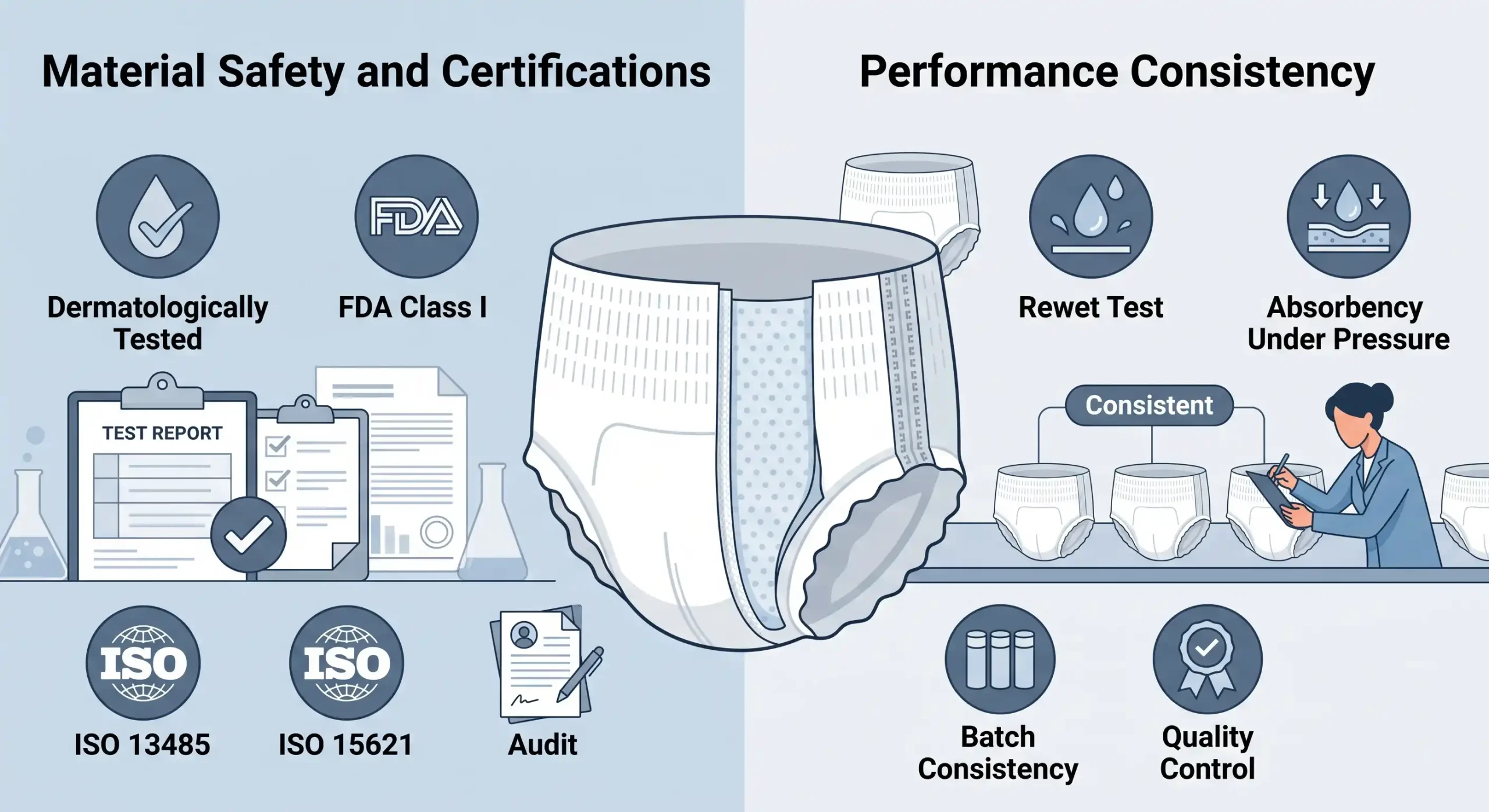
Skin lives inside these products for hours. If the non‑woven inner layer isn’t dermatologically tested for prolonged contact, irritation is almost guaranteed. Most adult incontinence products fall under the FDA’s Class I medical device classification, setting basic material safety requirements. Beyond that, serious manufacturers hold ISO 13485 for quality management and can supply test reports aligned with the ISO 15621 absorbency standard. A supplier that hesitates to share recent audit results raises an immediate concern.
Performance Consistency
Batch‑to‑batch consistency is what turns trial orders into long‑term contracts. The best facilities run rewet tests, stress side seams, and verify absorbency under pressure. According to surveys by the National Association for Continence, leakage protection outweighs bulkiness as a user preference by a wide margin. If a factory cannot guarantee that the 10,000th pull‑up performs like the approved sample, the partnership will eventually crumble.
Where to Source Qualified Adult Pull Up Pants Manufacturers
A targeted sourcing strategy cuts through the noise of online listings and helps you connect with legitimate factories directly. For B2B buyers seeking a professional Adult Pull Up Pants Manufacturer, three channels consistently deliver verified, high-quality leads:
– B2B marketplaces (Alibaba, Made-in-China): Generate broad supplier lists in minutes, but require extra due diligence to filter out trading companies and resellers that inflate costs and obscure factory accountability.
– Medical trade shows (Medica, Rehacare): Enable face-to-face conversations, on-site sample testing, and direct access to factory engineering and QC teams, ideal for assessing build quality firsthand.
– Industry association directories: Offer smaller, pre-vetted pools of manufacturers with verified compliance credentials, drastically reducing your upfront screening workload.
Once you’ve compiled a shortlist from these channels, it’s time to vet each Adult Pull Up Pants Manufacturer against concrete quality and operational standards.
Evaluating a Supplier Beyond the Brochure
MOQ, Logistics, and Communication
Some factories demand container‑load MOQs; others offer mixed orders for smaller brands. Asking for a live production schedule instead of a static quotation reveals how a manufacturer handles raw material shortages. Similarly, if a sales contact avoids connecting you with their QC manager, consider that a warning. Proactive weekly updates and shared inspection checklists separate a real partner from a transactional vendor.
| Manufacturer Type | Pros | Cons | Best For |
|---|---|---|---|
| OEM | Full design control, direct quality oversight | High MOQs, longer development time | Brands building proprietary designs |
| ODM | Faster turnaround, lower upfront R&D | Less exclusivity, limited core adjustments | Retailers seeking shelf‑ready products |
| Trading Company | Low MOQs, consolidates orders | Mark‑ups, limited factory floor visibility | Small distributors testing the market |
The Real Cost Equation
Unit price grabs attention, but hidden costs hurt more. Air freight surcharges, customs delays, and replacement stock for leaky batches inflate the actual bill dramatically. A supplier that offers a thoughtful range of Adult Incontinence Products — from light pads to heavy pull‑ons — often has deeper R&D roots, which tends to translate into tighter manufacturing tolerances across the entire line. That breadth can matter as much as the quote itself.
Red flags to avoid:
– Unwillingness to provide a live‑run sample instead of a lab‑perfect specimen
– No valid ISO 13485 certificate or MDSAP recognition
– Inconsistent sizing between two identical sample orders
– A price far below market norms, which often points to sub‑standard SAP or recycled fluff pulp
Conclusion
Choosing the right manufacturer is less about chasing the lowest sample cost and more about verifying the systems that guarantee consistent, skin‑safe performance. That patience costs nothing upfront and prevents expensive failures later.
FAQ
What’s the difference between pull‑up pants and tape‑on briefs in terms of dignity?
Pull‑ups are worn like regular underwear, preserving a sense of normalcy for active users. Tape‑on briefs, while offering higher side‑leak protection for immobile individuals, can feel clinical. Many caregivers now alternate between the two based on mobility, using pull‑ups whenever independence matters most.
How can absorbency claims be roughly verified without a lab?
A practical method: weigh a dry pull‑up, slowly pour room‑temperature saline solution onto the core until leakage appears at the leg cuffs, then weigh again. The difference gives a rough capacity estimate. While not as precise as a Rothwell test, it quickly flags a product that falls dramatically short of its stated rating.
Are there reusable or biodegradable options that still handle heavy incontinence?
Reusable cloth pull‑ups with snap‑in boosters can manage heavy voids but require rigorous laundering and antimicrobial treatment. Partially biodegradable disposables using plant‑based backsheets are emerging, yet most still struggle to match the rewet performance of top‑tier SAP cores. For full‑void heavy incontinence, proven disposables remain dominant.